Categories
- Blog (260)


The principle is quite simple. An evaporative cooler (also known as a wet curtain cooler) draws hot, dry outdoor air into a water-soaked cooling pad. As the air passes through the pad, water evaporates from its surface. This phase change absorbs a significant amount of latent heat from the air, causing a substantial drop in temperature. The cooled, humidified air is then transported into the indoor space. The efficiency of the entire process depends on the design and materials of the cooling pad.
Why Choose Plastic? Advantages Compared to Traditional Materials
Traditionally, cooling pads are made from aspen fiber or cellulose. However, rigid plastic cooling pads, typically made of PP, offer a number of significant advantages:
Plastic cooling pads have excellent resistance to corrosion, mineral scaling, and biological damage such as algae and mold. Unlike aspen wood, they do not rot or decompose in humid environments. With proper maintenance, plastic cooling pads can last 5-10 years or even longer, offering greater lifespan value.
Plastic cooling pads feature a precisely designed cross-corrugated structure, providing a large surface area for water distribution and air contact. Their robust structure maintains a stable channel geometry, ensuring uniform airflow, high evaporation efficiency, and resistance to sagging or clogging throughout their lifespan.
Perhaps their greatest practical advantage is ease of maintenance. When dust or scale builds up, the plastic cooling pads can be easily removed and cleaned with water, a mild detergent, or even a diluted descaling solution. They dry quickly and retain their shape, allowing for immediate reinstallation. This is a significant improvement over disposable cellulose cooling pads.
Plastic cooling pads can be reused for many years, generating less waste than cooling pads that are replaced annually. Furthermore, plastic is often recyclable at the end of its lifespan, contributing to a more circular economic model compared to disposable alternatives.
 Plastic cooling pads

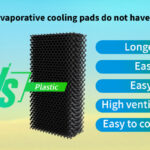 Comparison of Paper and Plastic Evaporative Cooling Media
 See you in Cairo—WUSEN is exhibiting at AGRENA Middle East 2026!
 Why are plastic pads replacing paper ones?
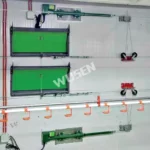 Poultry House Ventilation: WUSEN 908 Poultry Air Inlet
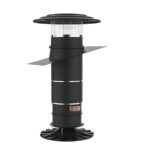 Optimizing Livestock Housing Ventilation: WS-T Series Chimney-Style Intake Fans