Categories
- Blog (260)


Made from high-molecular-weight polymers (such as PP), plastic mats are resistant to acid and alkali corrosion and UV degradation, with a service life of 5-10 years, far exceeding that of paper mats. Its surface is smooth and not prone to mold or scale accumulation. It can be restored to cleanliness by simply rinsing with a high-pressure water gun, reducing maintenance costs by more than 60%.
The core principle of plastic evaporative cooling mats is based on direct evaporative cooling technology: when unsaturated air comes into contact with a moist, porous surface, the water evaporates, absorbing sensible heat from the air and converting it into latent heat as water vapor, thereby lowering the air temperature and increasing humidity.
Corrugated Structure Design: The plastic mats utilize a U- or W-shaped structure to increase the contact area between air and water. This results in more even water distribution, reducing pressure drop by 30%, and increasing cooling efficiency by 15%.
Dynamic Water Flow Control: Unlike traditional paper mats, plastic mats require continuous circulation of a greater volume of water (approximately twice that of paper mats) to ensure complete wetting. While their surface water retention capacity is lower, they dry faster. Therefore, an intelligent control system is required to optimize the spray cycle to avoid over-drying and cooling interruptions.
 Evaporative Cooling Pads

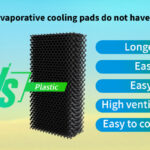 Comparison of Paper and Plastic Evaporative Cooling Media
 See you in Cairo—WUSEN is exhibiting at AGRENA Middle East 2026!
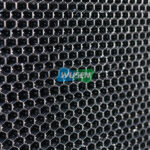 Why are plastic pads replacing paper ones?
 Poultry House Ventilation: WUSEN 908 Poultry Air Inlet
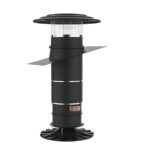 Optimizing Livestock Housing Ventilation: WS-T Series Chimney-Style Intake Fans