Categories
- Blog (260)


When choosing a cooling pad—a core component of an evaporative cooling system—consumers often face a crucial decision: plastic or traditional paper? These two mainstream materials differ significantly in performance, lifespan, and user experience. Choosing the wrong material can lead to poor cooling performance, frequent replacements, or even additional expenses. This article provides a detailed comparison guide to help you make the wisest decision based on your specific needs.
| Feature Dimension | Paper | Plastic |
| Cooling Efficiency | ★★★★★ Excellent, high water absorption and evaporation efficiency | ★★★☆☆ Good, but usually slightly lower than high-quality paper pads |
| Durability and Lifespan | ★★☆☆☆ Relatively short, usually 1-3 years, easily damaged | ★★★★★ Extremely long, up to 5-10 years, corrosion resistant |
| Maintenance and Cleaning | ★★★☆☆ Washable, but requires gentle pressure, easily damaged | ★★★★★ Easy to clean, washable, reusable |
| Cost | Low initial cost, but requires regular replacement | High initial cost, but no long-term replacement required |
| Suitable Water Quality | Sensitive to hard water, prone to scaling and clogging | More adaptable to water quality, scale is easy to clean |
| Environmental Protection | Biodegradable, but requires frequent replacement | Long-term use reduces waste, but it is a plastic product. |
Paper Evaporative Cooling Pads (Traditional, High-Efficiency Choice)
Paper cooling pads are typically made from special wood pulp fibers or plant fibers, chemically treated to increase their strength and absorbency.
Advantages:
Superior Cooling Performance: This is its biggest advantage. Paper fibers possess strong capillary action, enabling them to quickly and evenly absorb water and form a large water film surface area. Heat exchange (evaporation) efficiency is highest when air passes through, resulting in a typically greater cooling effect than plastic mats under the same conditions.
Excellent hydrophilicity: The material itself is hydrophilic, allowing for rapid wetting and quick access to optimal working conditions.
Low cost: The initial purchase price is significantly lower than plastic mats, making it more accessible for users with limited budgets or those who do not wish to make a long-term investment.
Disadvantages:
Shorter lifespan and susceptibility to wear and tear: Prolonged exposure to humid environments, even with treatment, can easily lead to the growth of microorganisms and algae, causing fiber decomposition. In hard water areas, limescale easily clogs the micropores and is difficult to clean thoroughly, leading to performance degradation and typically requiring replacement every 1-3 years.
Low mechanical strength: Prone to tearing or deformation during cleaning or installation if not handled carefully. Frequent cleaning also accelerates its damage.
High water quality requirements: Hard water (high mineral content) is its nemesis, significantly shortening its lifespan.

Plastic pads are typically made of high-density, corrosion-resistant polymers (such as PVC or PP) and have a honeycomb-like three-dimensional structure.
Advantages:
Extremely long lifespan and durability: This is its core competitive advantage. The plastic material is water-resistant, corrosion-resistant, anti-aging, and will not be decomposed by microorganisms. As long as it is not physically damaged, its lifespan can reach 5-10 years.
Easy to clean and maintain: The robust structure allows for direct rinsing with a water gun or even scrubbing with a mild detergent, easily removing scale and algae for a truly thorough clean.
Adaptable to harsh water conditions: Performs excellently in hard water areas. Even if scale forms on the surface, it is easier to clean physically, restoring most of its performance.
Disadvantages:
Slightly lower cooling efficiency: Plastic itself is hydrophobic, requiring special surface treatments or designs (such as micropores) to maintain a water film. Its overall water absorption and evaporation efficiency are typically about 5%-15% lower than top-tier paper pads, and this difference can be more pronounced in extremely dry environments. High initial investment cost: The purchase price is typically several times that of paper pads.
Potential environmental concerns: As a plastic product, its environmental impact during production and final disposal is greater than that of biodegradable paper pads.
You seek the ultimate cooling effect: You live in a very hot and dry region (such as Xinjiang or Inner Mongolia) and want the maximum temperature difference.
You have a limited budget: You want to solve the problem with the lowest possible upfront cost.
You don’t mind regular replacement: You are willing to accept a maintenance cycle of inspection and replacement every 1-2 years.
You have good water quality: You use soft or treated water.

You value long-term worth and durability: You don’t want frequent replacements and want a “one-and-done” solution.
You have hard water or inconvenient maintenance: Your area has a serious limescale problem, or you want easier and more thorough cleaning. Your usage scenario has excellent ventilation: For locations like large industrial workshops where extreme temperature differences aren’t critical, the slight efficiency loss of plastic pads can be compensated for by their extended lifespan and low maintenance costs.
You’re willing to pay a premium for convenience: You accept a higher initial investment in exchange for long-term peace of mind and lower total maintenance costs.
Paper pads are a short-term choice prioritizing efficiency, offering top-tier cooling performance at a lower entry price, but requiring more frequent maintenance and replacement costs.
Plastic pads are a long-term investment for durability and peace of mind, sacrificing a small amount of efficiency for a near-maintenance-free, extremely long lifespan, potentially resulting in a lower total cost of ownership.
Before making a decision, be sure to assess your local climate, water quality, budget, and patience for maintenance. Hopefully, this detailed comparison will help you choose the most suitable “lungs” for your evaporative air conditioner and enjoy a cool and efficient summer.


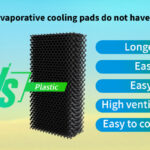 Comparison of Paper and Plastic Evaporative Cooling Media
 See you in Cairo—WUSEN is exhibiting at AGRENA Middle East 2026!
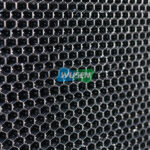 Why are plastic pads replacing paper ones?
 Poultry House Ventilation: WUSEN 908 Poultry Air Inlet
 Optimizing Livestock Housing Ventilation: WS-T Series Chimney-Style Intake Fans