Categories
- Blog (260)


| Item | Paper Cooling Pad (Traditional) | Plastic Evaporative Cooling Pad (New Type) |
| Material | Plant fiber + resin glue | PP/PVC plastic honeycomb/corrugated board |
| Cooling Efficiency | High (good water absorption, fast evaporation) | Slightly lower or similar (depends on structure) |
| Service Life | 2–5 years | 8–15 years |
| Corrosion Resistance | Average; sensitive to acid, alkali and disinfectants | Excellent; resistant to acid, alkali and disinfectants |
| Mold/Moss Resistance | Prone to mold and moss growth | Less mold and moss |
| Risk Resistance to ASFV/PRRS | Easy to trap dirt; hard to disinfect thoroughly | Easy to rinse; thorough disinfection possible |
| Cleaning Difficulty | Hard to wash; fragile under flushing | High-pressure washable; durable |
| Clogging Condition | Easy to clog with dust, feathers and manure | Not easy to clog; easy to unclog |
| Price | Low | Higher unit price |
| Maintenance Cost | High (annual replacement, fragile) | Low (long service life) |

2.1 Material
•Paper: Multi-layer kraft paper + phenolic resin glue, honeycomb structure, strong water absorption.
•Plastic: Engineering plastics such as PP and PVC, corrugated/honeycomb structure, non-water-absorbent, relying on surface water film for evaporation.

2.2 Cooling Efficiency
•Paper: Fast water absorption, large evaporation area, better cooling effect, and rapid humidity rise.
•Plastic: Evaporation relies on surface water film, with slightly lower efficiency, but the gap is small; high-quality structures achieve nearly equal performance.
2.3 Service Life (Biggest Difference)
•Paper: Generally 2–5 years; often deteriorates within 1 year due to poor water quality, frequent disinfection and repeated washing.
•Plastic: Normally 8–15 years; no rot, no pulverization, no brittle fracture.
2.4 Mold, Moss and Disease Prevention
•Paper: Extremely prone to mold and moss under long-term damp conditions, easy to trap dirt and residues. Unfavorable for respiratory diseases such as African Swine Fever (ASFV) and Porcine Reproductive and Respiratory Syndrome (PRRS); difficult to disinfect completely.
•Plastic: Smooth surface, non-water-absorbent, less mold and moss. High-pressure washable and disinfectable, more compliant with biosecurity standards.
2.5 Disinfectant and Acid-Alkali Resistance
•Paper: Sensitive to disinfectants, acids and alkalis; frequent disinfection accelerates decay.
•Plastic: Resistant to glutaraldehyde, potassium peroxymonosulfate, chlorine preparations and other common farm disinfectants.
2.6 Cleaning and Maintenance
•Paper: Not suitable for high-pressure washing; easy to damage; clogging usually requires replacement.
•Plastic: Direct high-pressure water gun washing allowed; easy to unclog and highly durable.
2.7 Total Cost
•Paper: Low upfront cost, but high total cost due to annual replacement, labor and downtime.
•Plastic: Higher one-time investment, but more cost-effective in the long run due to long service life.


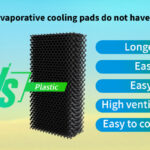 Comparison of Paper and Plastic Evaporative Cooling Media
 See you in Cairo—WUSEN is exhibiting at AGRENA Middle East 2026!
 Why are plastic pads replacing paper ones?
 Poultry House Ventilation: WUSEN 908 Poultry Air Inlet
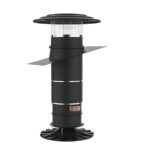 Optimizing Livestock Housing Ventilation: WS-T Series Chimney-Style Intake Fans