Categories
- Blog (260)


The evaporative cooling pad—essentially a corrugated fibrous paper subjected to a specialized impregnation treatment—has, by virtue of its unique design and material properties, established itself as a highly renowned and widely utilized product series within its field.
Core Construction and Materials
The core material of the cooling pad is a specialized cellulose paper. This paper undergoes a specific chemical impregnation process that endows it with critical performance characteristics: high water absorbency, sufficient structural strength to be self-supporting, and durability that resists decomposition and rot—factors that significantly extend the product’s service life.

Unique Unequal-Angle Corrugation Design
Its structural design is the key to its high-efficiency performance. The cooling pad is constructed by bonding together corrugated fibrous paper sheets set at varying angles; typically, one side features a steeper angle , while the other features a shallower angle.

This design offers several distinct advantages:
High Evaporative Efficiency:The unique angular configuration promotes thorough mixing of air and water, thereby achieving highly efficient evaporative cooling.
Low Air Resistance (Pressure Drop):It creates no significant obstruction to airflow, even at high air velocities, which helps to reduce operational costs.
Guided Water Flow:This design directs the water flow toward the air-intake side of the cooling pad. This is the zone where the air is hottest, driest, and contains the most impurities—precisely where evaporation is most intense and the need for water is greatest. This strategic approach—effectively “applying the water where it is needed most”—not only enhances efficiency but also mitigates issues related to mineral scale buildup and water carryover (water drift) into the airflow.

💡 Working Principle
The working principle is based on nature’s own evaporative cooling process—a process that requires no external energy input:
1. Water is delivered to the top of the cooling pad via a circulation system.
2. The water flows downward along the corrugated surface of the pad.
3. As dry, hot air passes through the cooling pad, a portion of the water evaporates.
4. The process of water evaporation requires the absorption of heat—heat that is drawn directly from the air itself. Consequently, the air exiting the cooling pad is cooler and more humid, thereby achieving the desired cooling effect.
5. Any remaining water serves to flush the pad, carrying away dust and impurities, before flowing back into the water reservoir to be recirculated.


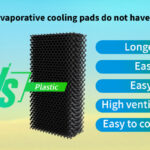 Comparison of Paper and Plastic Evaporative Cooling Media
 See you in Cairo—WUSEN is exhibiting at AGRENA Middle East 2026!
 Why are plastic pads replacing paper ones?
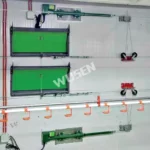 Poultry House Ventilation: WUSEN 908 Poultry Air Inlet
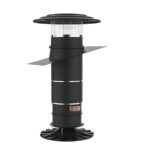 Optimizing Livestock Housing Ventilation: WS-T Series Chimney-Style Intake Fans