Categories
- Blog (256)


For decades, paper (cellulose) evaporative cooling pads have been the industry standard for poultry houses, pig farms, greenhouses, and industrial facilities. However, a new generation of plastic cooling pads is rapidly gaining popularity—and this is no coincidence.
Service Life: 1–3 Years vs. 10–15 Years
This is the most significant difference between the two materials.
Paper cooling pads typically last only 1 to 3 seasons before they begin to degrade, collapse, or become clogged due to mineral deposits and algae growth. If water quality is poor, their lifespan may be less than a year.
In contrast, plastic cooling pads are designed to last 5 to 10 years—and up to 8 to 15 years under normal operating conditions. Made from high-quality polypropylene (PP), they are resistant to rot, chalking, and brittleness.

Maintenance: Washing vs. Replacement
Paper cooling pads are fragile. They absorb water like a sponge, which means they also trap dust, feathers, feed particles, and mineral scale. Cleaning them carries risks; high-pressure washing often damages the delicate cellulose fibers. Once a paper pad becomes clogged, it is usually irreparable.
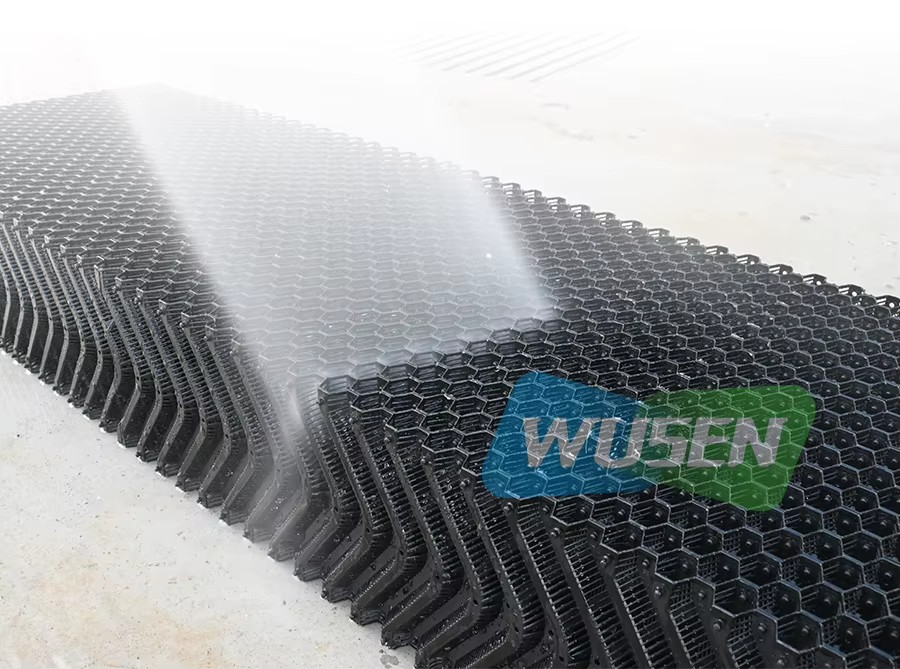
Plastic cooling pads are virtually indestructible. Their surfaces are smooth and non-porous, making them resistant to dirt accumulation. When cleaning is required, they can be washed directly with a high-pressure washer without shrinking, warping, or losing effectiveness. A simple rinse with a hose is often enough to restore full functionality.
Chemical Resistance
Agricultural environments are harsh, with ammonia, detergents, acids, and alkalis present everywhere.
Paper cooling pads are sensitive to disinfectants, acids, and alkalis; frequent cleaning can actually accelerate their deterioration.
Plastic cooling pads are inherently resistant to ammonia corrosion and UV radiation, and they withstand most agricultural chemicals. They do not degrade or sustain damage even with long-term use in harsh environments.

Consistent, Long-Lasting Performance
The efficiency of paper cooling pads declines over time. Cooling performance diminishes over time due to aging, water saturation, and the development of dry spots.
In contrast, plastic cooling pads maintain consistent performance year after year. Their robust structure and open-channel design ensure stable airflow and evaporation efficiency throughout their service life.
How effective is the cooling?
Field studies indicate that, when properly installed and operated, plastic cooling pads deliver cooling performance comparable to that of traditional paper pads. In fact, one study found that a pig barn equipped with a new air distribution system and plastic cooling pads consistently maintained lower intake air temperatures than a barn using paper pads.


 Optimizing Livestock Housing Ventilation: WS-T Series Chimney-Style Intake Fans
 Tunnel Air Inlets for Poultry Houses – WUSEN
 Choosing PVC-Framed Evaporative Cooling Systems for Greenhouses and Poultry Houses
 Fresh Air Inlets: Optimizing the Poultry House Environment
 Fresh Air Inlets for Poultry Houses