Categories
- Blog (260)


When cooling large spaces—such as poultry houses, swine barns, dairy farms, or greenhouses—evaporative cooling remains one of the most cost-effective and energy-efficient methods available. While traditional paper or aspen-fiber cooling pads have served as the industry standard for decades, a new contender has emerged as a superior long-term investment: plastic evaporative cooling pads.
Constructed from high-grade polypropylene (PP), these robust cooling pads are rapidly gaining favor among farmers and facility managers who are weary of issues such as frequent replacement, clogging, and biological growth.
The underlying principle is identical to that of traditional cooling methods. Water is circulated from a reservoir to the top of the cooling pad, where gravity causes it to flow downward across the large surface area of the plastic material. Simultaneously, exhaust fans draw hot air into the cooling pad.
As the water evaporates, it absorbs heat from the air (via the latent heat of vaporization), resulting in a significant drop in air temperature—typically ranging from 5 to 10°C (10 to 18°F). The sturdy plastic structure ensures uniform distribution of both water and air, thereby maximizing cooling efficiency.

Unrivaled Durability and Lifespan
Traditional cellulose-based paper cooling pads typically last only one to three seasons before beginning to degrade, collapse, or become clogged with mineral deposits and algae. In contrast, plastic evaporative cooling pads are engineered to last anywhere from 5 to 10 years—or even longer—under normal operating conditions. They are inherently resistant to corrosion, deformation, and delamination.
Superior Resistance to Corrosion and Chemicals
Agricultural environments can be harsh. Ammonia, cleaning agents, and various chemicals can rapidly degrade paper-based media. Plastic cooling pads are naturally resistant to ammonia corrosion and most agricultural chemicals, making them ideally suited for swine and poultry operations where air quality challenges are a constant concern.
Clog-Resistant and Easy to Clean
Most plastic cooling pads feature an open-channel design; combined with their smooth, non-porous surfaces, this structure effectively prevents the accumulation of dust, feed particles, and mineral scale. When cleaning is required, a simple rinse with low-pressure water or a soak in a mild acidic solution is sufficient to restore the pads to a near-original state. In contrast, paper-based cooling pads are typically irreparable once they become clogged.
Resistance to Biological Growth
Due to their porous and water-absorbent nature, paper-based cooling pads provide an ideal environment for the proliferation of mold, algae, and bacteria. Plastic cooling pads, however, do not absorb water—instead, water simply flows across their surface. This significantly reduces the risk of Legionella, algal blooms, and unpleasant odors, thereby contributing to enhanced biosecurity and animal health.
Durable and Stable Performance
The efficiency of paper-based pads tends to diminish over time due to aging, water absorption, or the formation of dry spots. Plastic pads, conversely, retain their rigid structure and open design for many years, ensuring consistent airflow (static pressure) and evaporative efficiency year after year.


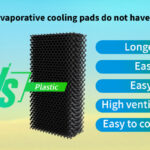 Comparison of Paper and Plastic Evaporative Cooling Media
 See you in Cairo—WUSEN is exhibiting at AGRENA Middle East 2026!
 Why are plastic pads replacing paper ones?
 Poultry House Ventilation: WUSEN 908 Poultry Air Inlet
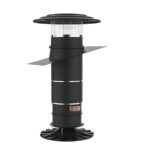 Optimizing Livestock Housing Ventilation: WS-T Series Chimney-Style Intake Fans